


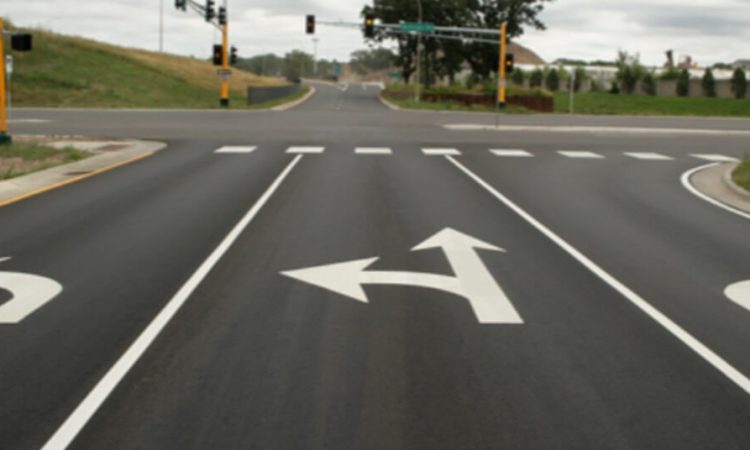

Meticulously, not all road markings are similar to each other. Although, a line describing the traffic lane is distinct from the line’s standard on airport runways or used for pedestrian crossings.
Distinct Country, Distinct Lines
When you consider that different countries classify and specify road surface marking in different ways, it becomes even more challenging. However, uniformity of markings is necessary for every country to give a clear direction to pedestrians and drivers and to reduce uncertainty regarding their meaning. As a result, a good road line striper will cover all potential line kinds.
Solid/Standard Lines
There is no such thing as a “standard line” because each country has its unique set of customs and regulations. A standard line’ in road marking is a single mono-colour solid line 100 to 150 mm broad.
As longitudinal marks along the direction, on the roadway, a solid line is frequently used to show the driver’s proper location. White and yellow are the most common colours utilised. They are frequently used in private applications to define individual parking space restrictions on a parking lot.
Wide Lines
Broad lines in road marking are 40 to 50 cm wide. This line style is used for various reasons, including pedestrian crossings and stop lines. For making wide lines, a single spray gun’s spray width is inadequate.
A line striper that combines two spray guns can create lines up to 60 cm wide. In order to generate a single homogeneous wide line, the two cannons should be situated at a distance that allows for incomplete overlap of the two distinct sprays. The location of the guns is crucial for the line quality. Lines of 90 cm width are common on airport runways. Three spray guns are required for jobs like this.
Skip Lines
Single broken line segments combine to generate skip lines. The colour, breadth, length, and distance between broken line segments can all be changed according to the country and their various purposes. Skip liners are used for many applications such as on highways and intersections.
To make it simple for creating precise skip lines, a road marking machine with automatic guns is used. However, with the press of a button, these robots can automatically draw the skip lines.
Although, the guns begin and end independently, depending on the programmable parameters for line segment length and interspace between two line segments. Since the line segment is drawn automatically, but the starting point of each line segment is set by you, a semi-automatic mode is helpful for restriping.
Double Lines
In road marking, double lines are frequently employed. They are installed in the middle of the road to separate traffic flow. They indicate whether crossing from one or both sides is permitted or not depending on their type. As a stopping line, a solid double line is sometimes utilised.
It is possible to draw multiple lines with a single gun by wrapping the same region two times, but it is inefficient. A line striper with two guns is a quicker and more intelligent option. You should get a machine with two automatic guns if you want to accomplish the work comfortably, quickly, and accurately. However, with a single button press, you can draw whatever type of double line you want.
Dula Line Colours
A dual colour line is not commonly seen on European highways. However, it is utilised in certain conditions. Primary traffic lanes are designated with yellow stripes in various nations. When the direct traffic lines change to white permanent markings, two colours are required. Dual colour lines are also utilised in airports if the contrast of white lines on a light grey concourse surface is insufficient.
Diagonal Lines
Meticulously, non-driving zones are frequently delineated with parallel diagonal lines. They can be thought of as straight solid lines that have been applied in a certain pattern. Calculating and implementing physical guiding lines typically takes a significant amount of time. You may make this process much easier by employing a road markings machine with spray tips adjusted to spray at a specific angle.